
In the summer of 1754, deep in the forests of the Ohio Valley, a young British colonial officer named George Washington led a small militia against French troops. The musket shots that crackled through the woods that day lit the fuse of a conflict that would rage across five continents. Within two years, Britain and France were formally at war, drawing in allies and empires from Europe to Asia. The Seven Years’ War (1756–1763) – known in North America as the French and Indian War – became so vast that Winston Churchill later called it “the first world war”. This is the story of how a struggle for empire in the wilderness of North America spiraled into a global war, reshaped nations, and set the stage for revolutions to come.
Tensions between Britain and France had been smoldering for years over control of North America. France claimed a vast inland territory from Canada down the Mississippi, while British colonies hugged the eastern coast. The flashpoint came in 1754 when Virginia’s governor sent Major George Washington to challenge French expansion in the Ohio Valley. In May of that year, Washington’s troops ambushed a French scouting party, and soon after he hastily built Fort Necessity in western Pennsylvania. The French counterattacked and forced Washington to surrender that fort – a small skirmish, but one with enormous consequences.
For the next two years, Britain and France engaged in undeclared hostilities in North America. Indigenous nations were drawn in as crucial allies on both sides; the French allied with Algonquin and Huron warriors among others, while the British courted the powerful Iroquois Confederacy. Many Native American tribes preferred the French, who were relatively few in number and focused on trade, over the land-hungry British colonists. These alliances turned frontier skirmishes into a wider war. After years of provocation and scattered fighting, Britain officially declared war on France in 1756, transforming a colonial scuffle into a full-scale conflict.
When war broke out, it did not remain confined to the New World. In Europe, old rivalries and dynastic ambitions were already on a knife’s edge. The recent War of the Austrian Succession (1740–1748) had left unresolved grudges – especially between Prussia and Austria over the rich province of Silesia. Sensing another fight was inevitable, the great powers reshuffled their alliances in what became known as the “Diplomatic Revolution” of 1756. Traditional enemies became unlikely friends: France and Austria, former foes, formed an alliance, while Britain – historically aligned with Austria – instead sided with Prussia under its brilliant king, Frederick the Great. Almost overnight, Europe’s balance of power realigned and the continent braced for war.
In late summer 1756, as soon as alliances were secured, Frederick of Prussia moved first. He launched a bold invasion of Saxony, determined to strike before his enemies could unite. This act ignited the European theater of the Seven Years’ War. Prussia, backed by British funds and the small army of Britain’s German kingdom of Hanover, now faced a formidable coalition of Austria, France, Russia, Sweden, and several smaller states. The war in Europe see-sawed dramatically. Frederick the Great won stunning victories – Rossbach and Leuthen – but also suffered terrible setbacks. In 1759, a combined Austro-Russian force crushed him at Kunersdorf, yet fortune returned when Russia withdrew in 1762 under a new tsar. Meanwhile, Britain and France clashed on the fringes of Europe. By 1761, all sides were exhausted, drained of men and money, and desperate for peace.
Back in North America, the war raged across dense forests, lakes, and the frontiers of empire. France’s Indigenous allies helped deliver early victories at Fort Oswego and Fort William Henry, where British forces suffered devastating defeats. But Britain’s fortunes changed when William Pitt became prime minister in 1757. He poured resources into the colonies, built up the Royal Navy, and financed Prussia’s war effort in Europe. In 1758, British forces under Jeffrey Amherst captured Louisbourg, the French fortress guarding the St. Lawrence River. With the gates to New France open, a daring assault followed.
In 1759, General James Wolfe led his troops up the cliffs to the Plains of Abraham, where they met the army of Louis-Joseph de Montcalm outside Quebec. The battle was short and fierce. Both commanders were killed, but Britain prevailed, and Quebec fell. A year later, Montreal surrendered. France’s empire in Canada collapsed, and New France was no more.
Beyond Europe and America, the war spread to the far reaches of empire. In India, Britain’s East India Company, led by Robert Clive, defeated the Nawab of Bengal and his French allies at Plassey in 1757, securing control over Bengal. By 1761, the fall of Pondicherry ended France’s ambitions in India. In the Caribbean, British fleets seized Guadeloupe, Martinique, and the Spanish port of Havana. In Africa, they captured Senegal. Across the oceans, Britain was dismantling France’s global network of colonies.
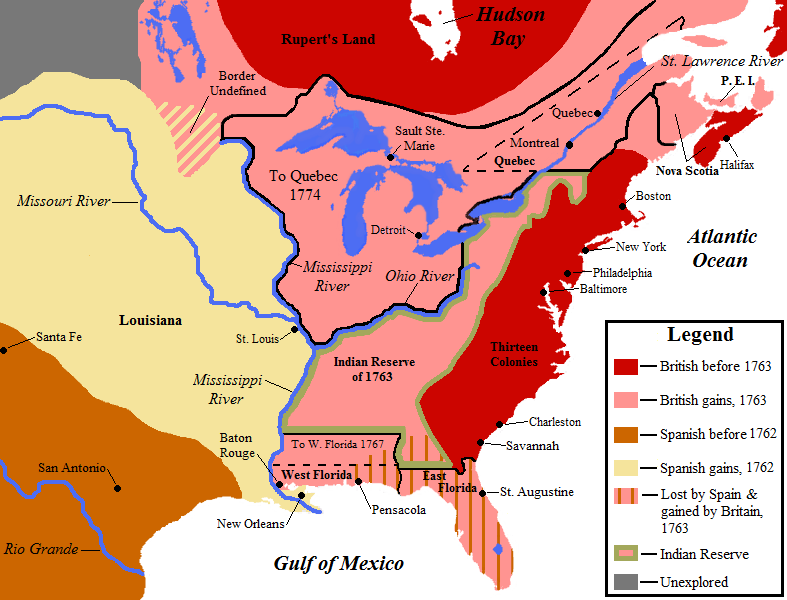
By the early 1760s, every combatant was exhausted. The British and their Prussian allies had the upper hand, but the costs were immense. Peace finally came in 1763 with the Treaty of Paris. France surrendered Canada and all its lands east of the Mississippi to Britain, ceded Louisiana to Spain, and gave up most overseas possessions. Spain traded Florida to Britain in return for Havana. Britain emerged the world’s dominant colonial and naval power. A second treaty, the Treaty of Hubertusburg, ended the European war between Prussia and Austria, confirming Prussia’s rise as a great power.
For Indigenous nations in North America, the peace of 1763 brought new dangers. Having fought as vital allies to both sides, they found their interests ignored in the treaties. With France gone, Britain claimed sovereignty over Indigenous territories and settlers surged westward, sparking violent conflict. In 1763, a broad Indigenous coalition led by Ottawa war chief Pontiac launched attacks on British forts and settlements in the Great Lakes and Ohio Valley. The uprising shook the empire. Britain responded with the Royal Proclamation of 1763, declaring lands west of the Appalachians reserved for Indigenous nations under Crown protection. It was a partial recognition of Indigenous rights, but settlers resented it bitterly, seeing it as an obstacle to expansion.
The Seven Years’ War transformed the world. Prussia emerged as a European power, while France’s defeat shattered its global empire and sowed the desire for revenge that would later fuel its support for the American Revolution. Britain became the richest and most expansive empire on Earth, but its triumph came at a heavy price. The massive war debt led Parliament to tax its colonies, provoking outrage and planting the seeds of rebellion. Within a generation, the American Revolution would erupt.
In Canada, English and French peoples were joined under British rule, shaping the foundation of a bilingual nation. Indigenous nations, though nominally protected by the Royal Proclamation, faced relentless encroachment as settlers pushed west. The Seven Years’ War was the first truly global conflict, fought from Europe to Asia, Africa, and the Americas. It ended one world and began another, its echoes carried through the centuries that followed.
Encyclopaedia Britannica: Seven Years’ War
The Canadian Encyclopedia: Seven Years’ War (1756–63)
National Army Museum (UK): Seven Years War overview
U.S. National Park Service: The French & Indian War portal
Fort Necessity National Battlefield (NPS): Opening engagement, 1754
Royal Museums Greenwich: The Battle of Quiberon Bay, 1759
National Army Museum: Battle of Plassey, 1757
Canadian War Museum: Seven Years’ War chronology
Yale Avalon Project: Treaty of Paris (1763) – full text
Yale Avalon Project: Royal Proclamation of 1763 – full text
Government of Canada (CIRNAC): The Royal Proclamation of 1763
U.S. Office of the Historian: Proclamation Line of 1763
The Canadian Encyclopedia: Pontiac’s War
The Canadian Encyclopedia: Battle of the Plains of Abraham
Encyclopaedia Britannica: Peace of Hubertusburg (1763)
Gilder Lehrman Institute: The American Revolution, 1763–1783 (context and consequences)



This website uses cookies to collect statistical data and to ensure you get the best experience on our website.