Joseph Trutch: Ambition and Controversy in Colonial British Columbia
Early Life in England and Jamaica
Joseph William Trutch was born on January 18, 1826, in the rural village of Ashcott, Somerset, in southwest England. His family’s early life straddled two very different worlds of the British Empire. As a young boy, Joseph spent several years in Jamaica, where his father managed land in the parish of St. Thomas. In the 1820s and early 1830s, Jamaica’s plantation society – built on slavery and colonial wealth – formed part of the backdrop of his childhood. In 1834, around the time slavery was being abolished in the British Empire, the Trutch family returned to England. They settled back in Somerset, and Joseph was sent to school at Mount Radford School in Exeter, Devon. There, he received a solid education and displayed a talent for mathematics and science.
As a teenager, Trutch pursued training in a field that would define his career: civil engineering. He was apprenticed to Sir John Rennie, a prominent British engineer renowned for designing bridges and railways. Under Rennie’s mentorship, Trutch worked on major infrastructure projects such as the Great Northern and Great Western Railways in England. By his early twenties, he had gained practical engineering experience and a sense of adventure. Britain’s industrial progress impressed upon him the power of engineering to reshape lands and economies. At the same time, stories of distant frontiers were capturing the public imagination, and Joseph Trutch was not immune to their allure. The young engineer began casting his gaze across the Atlantic, drawn by the promise of opportunity in North America.
Seeking Fortune in the American West
In 1849, news of gold strikes in California electrified ambitious young men throughout the British Isles. Twenty-three-year-old Joseph Trutch was among those lured by the prospect of fortune. He left England that year and sailed for San Francisco, arriving in the midst of the California Gold Rush. What he found, however, was not exactly the civilized opportunity he had envisioned. San Francisco was a raw, booming frontier town overflowing with prospectors, gamblers, and adventure-seekers from all over the world. To Trutch’s genteel English sensibilities, the city felt uncouth and chaotic. He wrote disappointed letters home describing San Francisco’s inhabitants as rough and vulgar. Part of his discomfort, he believed, was that he hadn’t yet fallen in with the “right kind of people” – the wealthy and well-connected – who could help advance his ambitions.
After a few rough-and-tumble months in California, Trutch decided to try his luck further north. By 1850 he had moved on to the Oregon Territory, which felt to him more promising and orderly than gold-crazed California. In Oregon, Trutch was able to secure work that made use of his engineering skills. He took contracts to survey and lay out new town sites, including the nascent settlements of St. Helens (on the Columbia River in what is now Oregon) and Milton (in what is now Washington State). By 1852, his competence earned him a position as an assistant surveyor in the U.S. Surveyor General’s Office for Oregon Territory. Trutch relished the professional opportunities on this young frontier, but his time there also exposed an aspect of his character that would later have serious consequences: his attitude toward Indigenous peoples.
While surveying around the Columbia River and Puget Sound, Trutch encountered Native American communities for the first time. Rather than sparking any empathy or curiosity, these encounters only reinforced ugly prejudices he already harbored. In letters to his family, Trutch described the Native residents in dehumanizing terms. He called them “the ugliest and laziest creatures I ever saw,” and scoffed that one might “as soon think of being afraid of our dogs as of them.” Such statements made clear his contempt for Indigenous people – a disdain that would guide his policies in the future. Trutch saw himself as a civilizer on a wild frontier and viewed the original inhabitants as obstacles or irrelevances to progress. These racist assumptions, common among colonials of his era, went unchallenged in Trutch’s mind and would harden further over time.
Despite his prejudices, Trutch was adept at cultivating relationships with influential non-Indigenous people who could further his career. One such figure was John B. Preston, the Surveyor General of Oregon Territory and Trutch’s supervisor. Impressed by Trutch’s work ethic, Preston took the young man under his wing. This connection also changed Trutch’s personal life: through Preston’s family, Joseph met Julia Elizabeth Hyde, a woman from New York who was Preston’s sister-in-law. Julia was educated, resourceful, and had come west with her relatives. Joseph and Julia courted for a short time and married in January 1855 in Oregon City. The marriage was childless, but it provided Joseph with a supportive partner as he navigated life in far-flung lands. Shortly after marrying, the Trutches left the Pacific coast for a new venture. Preston had offered Joseph another job back east, so the couple moved to Illinois.
In Illinois, Trutch worked as an assistant superintendent on the construction of the Illinois and Michigan Canal – a major infrastructure project connecting the Great Lakes to the Mississippi River system. He also dabbled in land speculation around the burgeoning city of Chicago. By now he was accumulating the savings and business savvy that could make him a wealthy man. Yet, the American Midwest did not satisfy Joseph Trutch. The canal work was slow and less lucrative than he hoped, the climate was harsh on his health, and he still felt like an outsider in the United States. By the late 1850s, he was restless again. A new opportunity was arising back on the west coast – this time in a British territory – and Trutch was keen not to miss it.
A New Frontier in British Columbia
In 1858, a dramatic discovery transformed the Pacific Northwest: gold was found in the sandbars of the Fraser River in British territory north of the U.S. border. The Fraser Canyon Gold Rush exploded that year, drawing thousands of prospectors into what soon became the Colony of British Columbia. For Joseph Trutch, the Fraser gold rush presented an irresistible chance to return to a British colonial environment, with all its prospects for profit and advancement. He wrote to his younger brother back in England that British Columbia sounded like a place where Englishmen could live “under our own laws and flag.” The appeal of a society governed by British norms – rather than the American republic he had found distasteful – was strong. Trutch hoped he might make his fortune amid the gold excitement while also enjoying the stability of British rule.
Determined to position himself for success in the new colony, Trutch made a calculated move: before heading to British Columbia, he went to London to seek official patronage. Using connections through his family and former colleagues, he managed to secure an introduction to Sir Edward Bulwer-Lytton, the British Secretary of State for the Colonies. Bulwer-Lytton furnished Trutch with a letter of recommendation to Governor James Douglas, who governed both the Colony of Vancouver Island and the new mainland Colony of British Columbia. Trutch also met Colonel Richard Moody, the commander of the Royal Engineers detachment being sent to British Columbia to survey and build infrastructure. These meetings in London did not land Trutch an immediate job, but they gave him something almost as valuable in the colonial world: powerful contacts and a favorable reputation preceding him.
Armed with letters of introduction and renewed optimism, Joseph Trutch set sail around the globe. He arrived at the harbor of Victoria (the capital of Vancouver Island) in June 1859. At that time, Victoria was a booming little port filled with prospectors en route to the Fraser Canyon and officials trying to impose order on the gold rush. Not long after arriving, Trutch traveled to the mainland to present himself in New Westminster, the capital of British Columbia, and to meet Governor Douglas. Though no permanent civil service post was available immediately, Douglas was aware of Trutch’s engineering credentials and was inclined to make use of him. Before long, Trutch secured his first colonial contract: surveying along the lower Fraser River. This was vital work in a rapidly developing region where towns, roads, and farms were springing up.
Over the next few years, Joseph Trutch made himself indispensable as an engineer for hire in British Columbia. The colonial administration awarded him a series of contracts to improve transportation routes into the goldfields of the interior. One of his early projects was helping to develop the Harrison–Lillooet Trail, a critical pack-horse route that led miners from the coast to the Fraser Canyon in the rush of 1858–59. His most famous engineering achievement came a few years later, as the gold frenzy moved further north into the Cariboo region. In 1862, Trutch won the contract to construct a key section of the Cariboo Road, the wagon road that would connect Yale to Barkerville and facilitate access to the goldfields. His portion ran through the rugged Fraser Canyon from Chapmans Bar to Boston Bar – terrain that posed enormous challenges.
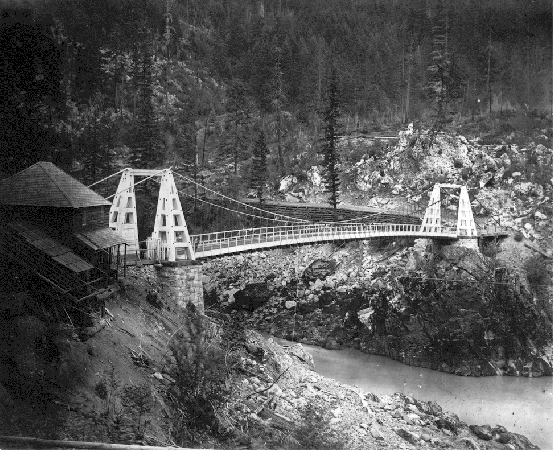
Trutch tackled those challenges with skill and determination. The crowning accomplishment of the project was the Alexandra Suspension Bridge, which he built across the Fraser River near Spuzzum. Completed in 1863, this suspension bridge was an engineering marvel for its time and place: it spanned 268 feet across a turbulent river gorge and stood about 90 feet above the water, capable of supporting heavy wagon loads. At its opening, the Alexandra Bridge was rightly hailed as a feat of modern engineering in the wilderness of British Columbia. For Joseph Trutch, it was not only a professional triumph but also a financial windfall. As part of his contract, the colonial government allowed him to operate the bridge as a toll concession for several years. Gold seekers and freight wagons funneling into the interior paid to cross, and Trutch reaped the profits. By some estimates, his take from the bridge tolls ranged from $10,000 to $20,000 per year – an astounding income in the 1860s. Joseph Trutch was swiftly becoming a rich man.
Trutch proved shrewd with the wealth he was accumulating. As a surveyor, he had first pick of knowledge about promising lands in the colony. He used that inside information to acquire extensive real estate holdings. On Vancouver Island, for example, he snapped up choice farmland and town lots near Victoria. Land and property speculation, bolstered by his earnings from contracts, made him one of the colony’s most prosperous private citizens within a few short years. By the early 1860s, Joseph Trutch had firmly established himself in British Columbia – not only as a talented engineer and businessman but as an influential figure in colonial society.
Rising in Colonial Politics
Successful contractors and businessmen in a small colonial society often found their way into politics, and Joseph Trutch was no exception. As his stature grew, he began to take an interest in the governance of the colonies. In 1860, he moved his primary residence to Victoria, the social and political hub, even as he continued to work on projects across the region. It wasn’t long before an opportunity arose for Trutch to enter public office. In November 1861, a by-election was held for the Vancouver Island House of Assembly (the local legislature of the Colony of Vancouver Island) to fill a vacancy in one of the Victoria districts. Trutch ran for the seat and won, joining the assembly as a representative for Victoria.
In the House of Assembly, Trutch’s tenure was relatively short-lived and not especially distinguished – largely because he was often absent, still busy managing construction projects on the mainland. He served alongside notable figures like Dr. William Fraser Tolmie and Captain James Trimble as fellow Victoria representatives. Trutch’s legislative stint lasted only until early 1863, when the assembly was dissolved for a general election. He did not stand for re-election, preferring to focus on his lucrative engineering work. Nonetheless, his brief foray into elective politics helped raise his profile and, more importantly, brought him into the circle of the colony’s decision-makers. He came to know influential men such as Attorney General Henry Pering Pellew Crease – an old school friend from England – and others in Governor Douglas’s administration. These connections would soon prove valuable.
By 1864, a major change was underway in the governance of British Columbia. Governor James Douglas, the dominant figure of the region for a decade, was retiring under gentle pressure from London (which felt he had grown too powerful, governing two colonies at once). At the same time, the detachment of Royal Engineers led by Colonel Moody was being recalled to England, leaving a void in the colony’s public works leadership. The position of Chief Commissioner of Lands and Works for British Columbia – essentially the colony’s top civil engineer and land administrator – was coming open. Given Joseph Trutch’s skills, experience, and newfound political connections, he was a prime candidate for the job.
In April 1864, Governor Douglas made the controversial decision to appoint Joseph Trutch as the new Chief Commissioner of Lands and Works for the mainland colony of British Columbia. This powerful post put Trutch in charge of all public infrastructure projects, land surveys, and the allocation of Crown lands to settlers. It also came with a seat on the Executive Council (the small cabinet of advisors who ran the colonial government day-to-day). Trutch’s appointment raised some eyebrows across the colony. Critics in the local press pointed out that he had extensive personal landholdings and business interests – a clear conflict of interest for someone now tasked with deciding public land grants and government contracts. Indeed, there were grumblings that Trutch might use his office to further enrich himself or his friends. The new commissioner moved quickly to deflect these concerns: he announced that he would transfer his profitable Alexandra Bridge toll concession to his brother, John Trutch, so that he personally would no longer draw income from it. This gesture placated some opponents, though it was largely a cosmetic change since the benefit stayed in the family. Despite the criticisms, the colonial government and many settlers accepted that Trutch’s engineering expertise and drive were assets the administration sorely needed. British Columbia was a young colony facing economic uncertainties, and having a competent man oversee lands and works was seen as critical.
High Society and Personal Influence
As Joseph Trutch assumed his new mantle of authority, he also solidified his status in the upper echelons of colonial society. By the mid-1860s, he and Julia were living in a grand home called Fairfield House on the outskirts of Victoria. The house commanded a beautiful view over the Strait of Juan de Fuca and quickly became a center of social activity for the colony’s elite. Sir James Douglas (now retired from governorship) was a personal friend, as were the likes of Chief Justice Matthew Begbie and other leading figures. Trutch’s sister Caroline had married Peter O’Reilly, a prominent gold commissioner and magistrate, linking the Trutch family with another influential clan. In 1870, Trutch’s brother John married Zoe Musgrave, the sister of the incoming Governor Anthony Musgrave – entwining Trutch’s world with the highest circles of power. Colonial British Columbia was a small, tightly interconnected society, and Joseph Trutch was at its heart.
Trutch thrived in this environment of gentleman’s clubs, dinner parties, and backroom deals. He was known to enjoy fine imported cigars and maintained an excellent wine cellar at Fairfield House for entertaining. On Sundays, he would attend service at Christ Church Cathedral and was even called upon to read the lesson on occasion – a visible display of respectability. Beneath the veneer of Victorian gentility, however, lay a network of businessmen-turned-officials who generally agreed on how the colony should be run. They shared a vision of progress defined by British settlement, commerce, and resource development. To them, the rights or welfare of those outside their circle – particularly the Indigenous peoples of the land – were a distant concern at best. Joseph Trutch fit in perfectly. He and his compatriots believed they were building a prosperous new society, and they were prepared to give short shrift to anyone or anything that impeded that goal.
Within these elite circles, Trutch’s blunt views on race were no secret. Around the dinner table or in his office, he freely voiced the opinion that Indigenous inhabitants should not stand in the way of British Columbian development. Unlike his mentor-turned-colleague James Douglas, who had some mixed-race heritage and a corresponding empathy for Indigenous peoples, Trutch had no such personal connection. He embodied the prejudices of an imperial Englishman who regarded non-Europeans as inherently inferior. In the colonial social scene, such views were often accepted without challenge, even applauded, as aligning with the “civilizing mission” of the British Empire. This consensus would embolden Trutch to take official actions that carried out his vision of whose interests the land should serve.
Denying Indigenous Land Rights
Joseph Trutch’s most lasting – and infamous – legacy stems from his tenure as Chief Commissioner of Lands and Works, when he took charge of British Columbia’s policies toward Indigenous lands. In this role, Trutch essentially controlled how much land would be set aside for the First Nations of the colony and how the colonial government would (or would not) acknowledge Indigenous claims. His approach marked a sharp and drastic departure from the path laid by James Douglas. During Douglas’s administration, especially in the 1850s, there had been at least some effort to respect Indigenous land rights: Douglas had negotiated a series of small land treaties on Vancouver Island and had established Indian reserves in various locations, often consulting with local chiefs about their size and location. He believed that Indigenous people would have a place in the future of the colony and that they deserved a protected minimum of land to sustain their communities. Douglas’s policy was far from generous by modern standards, but it recognized Indigenous presence and sought to avoid the worst of settler encroachment.
Trutch, by contrast, saw even Douglas’s limited measures as overly indulgent to Indigenous people. As soon as Douglas retired and Trutch took the helm of lands policy (by the mid-1860s), he moved to nullify any notion that First Nations had inherent rights to land. Trutch flatly refused to acknowledge Aboriginal title – the idea that Indigenous peoples have ownership of their ancestral lands by virtue of original occupation. In his mind, all the land in British Columbia belonged to the Crown (and effectively to the settlers who would develop it), and Indigenous inhabitants had no legal claim to it whatsoever. The prevailing practice of not signing new treaties continued, meaning the vast bulk of the territory was simply deemed Crown land open for non-Indigenous use without Indigenous consent or compensation.
Even more impactfully, Trutch targeted the Indian reserves that had already been established. He took the view that the reserves laid out under Douglas were excessively large and “entirely disproportionate” to the number of Native people using them. To Trutch, it was intolerable that fertile valleys or rich pasturelands should be left in the hands of Indigenous families when white farmers and ranchers were eager for land. With the backing of the colonial government, he launched a systematic campaign to reduce reserve sizes across British Columbia. In practice, this meant that government surveyors, under Trutch’s orders, would simply redraw reserve boundaries and drastically shrink them, often without warning or agreement from the affected First Nations. For example, in the interior around Fort Kamloops, the Secwepemc (Shuswap) people had been originally allotted a large reserve around their village. Trutch cut it down to a fraction of its former extent. In the Fraser Valley, fertile lands that Indigenous communities had been cultivating or grazing were excised from reserves and thrown open for colonial settlement. Time and again, reserves that once measured in the thousands of acres were reduced to a few hundred or even just a few dozen acres.
Trutch did not hide his rationale for these actions – in fact, he trumpeted it. He argued that Indigenous people, whom he viewed as lazy and uncivilized, were not making “proper” use of extensive lands, and that it was against the public interest to let rich acreage lie “unproductive” in Native hands. “The land,” Trutch explained, “remains in an unproductive condition, is of no real value to the Indians and utterly unprofitable to the public interests.” Since he believed Indigenous peoples neither needed nor deserved good land, he felt justified in reallocating it to industrious white settlers who would farm, log, or mine it. It was a policy of dispossession couched as common-sense progress. Trutch even went so far as to doctor the historical record to defend what he was doing. In official correspondence, he misrepresented Governor Douglas’s intentions, suggesting that Douglas had never meant to grant permanent large reserves and that any earlier understanding to that effect was a mistake. This was a falsehood – Douglas had explicitly told his agents to protect reserve lands – but most colonists were none the wiser, and the British Colonial Office was too distant to know the truth on the ground.
For the Indigenous peoples of British Columbia, Trutch’s policies were devastating. Chiefs who protested the seizure of their lands were brushed aside. Some traveled to Victoria or sent petitions, only to be told by Joseph Trutch that their people had no legitimate claim and should be grateful for whatever small patches of land they were allowed to keep. The colonial government under Governor Frederick Seymour (Douglas’s successor) fully backed Trutch’s stance; indeed, Seymour was of a similar mindset regarding Native issues. Together, they ensured that by the end of the 1860s British Columbia’s official approach to Indigenous lands was one of uncompromising denial of rights.
At the time, there was little effective opposition to these oppressive measures. The settler population – still a relatively small fraction of the overall population but holding the reins of power – largely approved of opening more land for themselves. Newspapers ran only muted criticism, if any, about the injustice being done to the First Nations. In fact, many colonists saw Trutch as a strong leader who was clearing obstacles (in their view) to the growth of the colony. The full consequences of his Indian land policy would only become apparent in the decades and century to follow. Trutch had set British Columbia on a path unlike any other in Canada, one where almost no treaties existed and Indigenous peoples were confined to tiny reserves. This “Indian land question,” as it came to be known, festered unresolved, leading to generations of legal disputes, social struggles, and bitterness that would trouble the province long after Joseph Trutch was gone. His tenure in colonial office, while successful by the measures of his contemporaries, planted the seeds of a historic injustice that still echoes in British Columbia today.
The Road to Confederation
As the 1860s progressed, British Columbia’s settler society faced a turning point. The gold rush, which had been the engine of the economy, was winding down. By 1866 the easy gold had largely petered out, and many transient miners moved on. The colony’s revenues fell sharply, leaving the government in debt and the future uncertain. In response to financial strains, the British government had merged the two western colonies (Vancouver Island and British Columbia) into one in 1866, with Victoria as the capital. Joseph Trutch continued as Chief Commissioner of Lands and Works for the unified Colony of British Columbia, and he now sat on an expanded Legislative Council that advised the Governor. The colony’s leaders, Trutch among them, scrambled to find solutions to their economic woes. Two possibilities loomed: forging a union with the newly formed Dominion of Canada to the east, or, as a radical alternative some whispered about, potentially joining the United States.
Trutch, ever the British loyalist, was adamantly opposed to any notion of American annexation. His years in the United States had left him with a distaste for American democracy and a strong preference for British institutions. The idea of British Columbia becoming part of the United States was, to him, unthinkable. However, he was initially cool towards the idea of joining Canada as well. Like many colonial officials and merchants in Victoria, Trutch enjoyed the semi-autonomous power they held and worried that becoming just another province in Canada might diminish their influence. There was also a cultural hesitation: British Columbia felt geographically and even psychologically closer to Britain (by sea) than to distant Ottawa, which could only be reached by a long journey across the continent or by ship via Panama. Trutch and his peers cloaked their reluctance in proud imperial sentiment, proclaiming that British Columbia should remain under the British flag rather than yoke itself to an upstart confederation. But beneath that, they were also concerned about their own positions – would a new provincial government swept in by Confederation push aside the old colonial clique?
The impasse began to break in 1869 with the arrival of a new Governor, Sir Anthony Musgrave. Musgrave had marching orders from London: facilitate British Columbia’s entry into the Dominion of Canada as soon as possible. Knowing he faced resistance from the colonial establishment, Musgrave used both charm and assurances to win them over. Joseph Trutch in particular found Musgrave to be a kindred spirit – not only did the two men become close friends, they effectively became family when, in 1870, Trutch’s brother married Musgrave’s sister. Governor Musgrave privately promised Trutch and other officials that Confederation would not leave them out in the cold. London had authorized him to offer pensions or positions to any important men who might lose power in the transition. For Trutch, Musgrave hinted at the prospect of a secure role or financial compensation under the Canadian regime. These guarantees helped soften Trutch’s stance considerably.
By late 1869, Joseph Trutch had shifted from skeptic to advocate of union with Canada. Always pragmatic, he saw that British Columbia could not continue indefinitely as an isolated, cash-strapped colony. Confederation offered a way out of economic crisis by linking with the larger Canadian economy – and, crucially, by getting Canada to assume the colony’s debt and fund big projects like a transcontinental railway. In early 1870, Trutch used his position on the Legislative Council to push Confederation discussions forward. He emerged as one of the leading voices in favor of negotiating terms to join Canada. He argued passionately that if British Columbia could secure a promise of a railway connecting to Eastern Canada, the province would gain the access to markets and immigration it desperately needed. Trutch and many settlers dreamed of a steel highway that would bring prosperity, settlers, and goods directly from back east, ending the colony’s physical isolation.
The Legislative Council voted to send a delegation to Ottawa to negotiate with the Canadian government. In 1870, Joseph Trutch was appointed as one of three delegates – and quickly became the delegation’s driving force. The other two, John Sebastian Helmcken and Dr. Robert Carrall, were influential in their own right, but both later acknowledged that Trutch took the lead. The trio arrived in Ottawa in the spring of 1870 to hammer out the terms under which British Columbia would enter Confederation. Trutch, with his sharp mind and tenacious bargaining style, impressed the Canadian officials (including Prime Minister John A. Macdonald). He secured a deal beyond what British Columbians had even hoped: Canada agreed not only to take on the colony’s debts but also to build the Pacific railway, starting construction within two years of BC’s entry and finishing it within ten years. This promise of a transcontinental railway – effectively tying British Columbia to the rest of Canada with iron rails – was the linchpin of the agreement and a personal triumph for Trutch.
There was, however, a subtler aspect of the negotiation where Trutch’s influence had a more troubling effect. He crafted a clause in the Terms of Union concerning Indigenous peoples (referred to as the “Indian clause”). It stated that upon joining Canada, “the charge of the Indians, and the trusteeship and management of the lands reserved for their use and benefit” would be assumed by the federal government, and that Canada would pursue “a policy as liberal as that hitherto pursued” by the British Columbia government. On the surface, it sounded as though British Columbia was securing a commitment that Indigenous peoples would be treated generously. In reality, Trutch knew that British Columbia’s policy (which he himself had set) was anything but liberal toward Indigenous rights. By inserting that phrase, he effectively bound Canada to maintain BC’s minimal-reserve, no-treaty approach. Canadian officials, largely ignorant of the details of BC’s Indian policies, agreed to the wording without realizing its implications. It would take years for the federal government to grasp that “as liberal as British Columbia’s” actually meant an extreme denial of Native land rights – a realization that later led to conflict between Ottawa and Victoria over Indigenous policy.
After intense negotiations, the British Columbia terms of union were finalized. Trutch and the delegation returned home victorious, and in early 1871 the plan was presented to British Columbia’s unelected Legislative Council (the last colonial council before Confederation). It was approved overwhelmingly. In May 1871, as final preparations for union were underway, Joseph Trutch made one more move that stirred controversy. Fearing that the ambitious railway deadline might spook Canadian legislators, Trutch gave private reassurances to Prime Minister Macdonald and his ministers that British Columbia would be reasonable if the railway took longer than promised. Essentially, he hinted that BC wouldn’t secede or raise hell if Ottawa failed to meet the ten-year timeline, as long as good faith efforts were made. This quiet concession helped ease the union’s approval in the Canadian Parliament, which might have balked at the strict terms. However, when word of Trutch’s behind-the-scenes assurance leaked out back in BC, some locals were furious. They felt he had undercut the province’s chief bargaining chip – the ironclad railway promise – without a mandate to do so. Despite this murmuring of dissent, it did not derail the process. On July 20, 1871, British Columbia officially entered Confederation as Canada’s sixth province. Joseph Trutch, more than any other individual in the colony, had steered this outcome and tied the isolated Pacific shore to the rest of the nation.
First Lieutenant Governor of British Columbia
British Columbia’s union with Canada brought immediate change to Joseph Trutch’s career. The Prime Minister, Sir John A. Macdonald, wished to reward Trutch for his role in bringing the new province into being. The most prestigious reward within gift of the federal government was the post of Lieutenant Governor – the Crown’s representative and de facto head of state in the province. Thus, in July 1871, Joseph Trutch was appointed as the first Lieutenant Governor of British Columbia. At 45 years old, he found himself at the ceremonial pinnacle of provincial office.
Trutch’s new position was an honor, but it came with limited power. Under the terms of Confederation, British Columbia was to have “responsible government,” meaning a democratically elected legislature and an executive (Premier and cabinet) that needed the support of that legislature. The Lieutenant Governor’s role was largely symbolic and procedural – opening the legislature, giving royal assent to laws, and acting on the advice of elected officials. This set-up was ironically something Trutch had resisted in the colonial era, when he and others preferred rule by appointed governors and councils. Now he was tasked with overseeing the very system he once opposed, and some skeptics wondered whether Trutch would truly stay above the political fray.
In the early days of provincial government, Trutch did wield influence beyond the purely ceremonial. Since British Columbia had to hold elections and form a new government from scratch, he took it upon himself to guide the process. He set the date for the first provincial election in October 1871. Even before the results came in, Trutch selected a group of temporary advisors (effectively a proto-cabinet) to help run things. When the election concluded and the new Legislative Assembly met for the first time in 1872, Trutch chose John Foster McCreight, a lawyer and personal acquaintance, to be the first Premier and form a government. McCreight’s administration was packed with men from the old colonial establishment. This led critics to complain that Confederation had simply put a new label on the same oligarchy that had always run British Columbia – and that Trutch, as Lieutenant Governor, was ensuring his friends stayed in power.
One of the loudest critics was Amor De Cosmos, the firebrand newspaperman-turned-politician who had been a driving force for responsible government and union with Canada. De Cosmos won a seat in the new legislature and lost no time in challenging the status quo. He demanded that the Trutch-appointed government demonstrate it had the confidence of the elected Assembly. In short order, McCreight’s government was defeated in a vote, and McCreight resigned. Trutch, now obliged to find a new Premier, reluctantly called on Amor De Cosmos to form the next government in December 1872. De Cosmos became Premier and made it clear that British Columbia’s era of appointed rule was over. He insisted on the primacy of elected officials and kept a wary eye on Trutch to ensure the Lieutenant Governor did not overstep his constitutional bounds.
After 1872, Joseph Trutch’s political influence waned significantly. As the machinery of responsible government took hold, Trutch settled into the more neutral role envisioned for a Lieutenant Governor. He opened sessions of the Legislature with the traditional Speech from the Throne and hosted official ceremonies at Government House in Victoria. In correspondence, he sometimes chafed at the relatively passive duties, finding them less engaging than the days when he could dictate policy. Nonetheless, Trutch still found avenues to contribute on issues he cared about. For example, he quietly advised the federal government to continue British Columbia’s restrictive Indigenous land policy. Ottawa, now formally in charge of “Indians and lands reserved for Indians” under the terms of union, initially tried to nudge BC towards a slightly more generous approach on reserves. Trutch undermined those efforts, reassuring provincial officials and like-minded federal allies that his old policies should remain in place. True to his convictions, he maintained that large reserves or treaty settlements were unnecessary, and he intended to see his vision persist despite Confederation.
Trutch also played a role in international matters that touched British Columbia. One issue was the San Juan Islands dispute – a leftover quarrel between Britain and the United States over the marine boundary west of Vancouver Island. In 1871, an international arbitration (led by the Kaiser of Germany) was to decide whether the islands belonged to Britain (as part of the Colony of Vancouver Island) or to Washington Territory in the U.S. Although Trutch had no official say in the arbitration, he strongly advocated for Britain’s claim in communications with Canadian and British officials. When the decision ultimately went against Britain in late 1872 (the islands were awarded to the U.S.), Trutch was disappointed but had expected little better from what he considered American-favoring diplomacy. He was more successful in influencing British Columbia’s stance on the Alaska boundary. Throughout his term, he pressed for a hard British line on where exactly the Alaska–BC border should run, anticipating future disputes over that remote frontier.
By 1875, nearing the end of his term, Joseph Trutch was feeling the personal effects of power’s ebb. He had been at the center of British Columbia’s transformation for over a decade. Now the province was moving on under a new generation of elected politicians, and Trutch often found himself on the sidelines. He carried out the pomp and protocol of his office dutifully, but privately he admitted to friends that he missed the excitement of being in the thick of development and politics. He even quipped that apart from the pleasant climate, British Columbia seemed to him “a good place to leave” when one had no active role. On June 1876, his term as Lieutenant Governor came to its close. Joseph Trutch stepped down, ending his tenure as the Queen’s representative in BC.
Railway Dreams and Return to England
After leaving the Lieutenant Governor’s office, Trutch faced a crossroads. Still only 50 years old, energetic and wealthy, he was not ready to retire completely. However, the political landscape in British Columbia had shifted. He had no desire to run for elected office, and the new provincial government was firmly in the hands of others. For a man used to being at the heart of events, life on the periphery did not appeal. So Trutch set his sights elsewhere. In 1876, shortly after his viceregal term ended, he departed British Columbia and traveled back to England. For the first time in 17 years, he returned to the country of his birth with the intent of staying for a while. England, with its familiar comforts and status as the center of the empire, exerted a strong pull on him. Trutch settled in Somerset and used his connections to probe for another posting within the British imperial system. Perhaps another colonial governorship or a prestigious commission could be obtained with his résumé and knighthood (he had been named a Companion of the Order of St. Michael and St. George some years earlier). He waited as an English gentleman of leisure, tending to family matters and enjoying the society of London and Somerset.
Meanwhile, events in Canada were shifting again in a direction favorable to Trutch. In 1878, Sir John A. Macdonald – Trutch’s ally who had championed BC’s entry to Confederation – returned to power as Prime Minister after a few years out of office. Macdonald was gearing up to fulfill the great promise of building the Canadian Pacific Railway (CPR) to the west coast, a project that had stalled under the previous government. To Macdonald, having experienced and loyal people on the ground in British Columbia was essential to push the railway through the formidable mountains and to smooth over local hurdles. Joseph Trutch’s name naturally came to mind. He knew the province intimately, had engineering expertise, and was well acquainted with the byzantine land ownership issues there. Macdonald’s government approached Trutch and offered him a newly created position: Dominion Agent in British Columbia.
The Dominion Agent role, which Trutch accepted in 1880, made him the Canadian federal government’s chief representative in BC for matters that fell under Ottawa’s jurisdiction. In practice, his top priority was the transcontinental railway. Trutch sailed back to Victoria and re-immersed himself in the affairs of the province, this time as an emissary of the national government. He coordinated surveys for the rail line and negotiated with the provincial authorities on issues like the exact route and the lands that would be granted to the railway company. One contentious task was determining the so-called “railway belt” – a strip of land, 20 miles on either side of the planned rail line, which British Columbia had agreed to give to Canada to aid construction. This belt would then be used to sell land to settlers and to reward the railway builders. Trutch oversaw the transfer of this vast tract (millions of acres) from the province to the Dominion. In doing so, he encountered a complication: some sections of the intended belt were already settled or deemed impractical (mountainous terrain where a railway couldn’t run straight). To compensate, Trutch was instrumental in identifying an alternative block of land that Canada could take – he chose a huge swath in the Peace River region of northeastern BC, a relatively fertile area that at the time had very few settlers. The inclusion of the Peace River Block in the deal was controversial locally (since it was far from the railway line), but Trutch saw it as a savvy trade to ensure Canada got its full measure of land entitlement.
In carrying out his duties, Trutch remained consistent in his approach to Indigenous issues. Now that Ottawa was formally in charge of Indigenous affairs in BC, the question was how to implement a uniform Canadian Indian policy in a province with very different precedents. Many in the federal Department of Indian Affairs were beginning to realize that British Columbia had almost no treaties and inadequately small reserves. There was talk of revisiting some of the earlier reserve reductions and perhaps negotiating treaties similar to those on the Prairies. Trutch moved quickly to stifle such notions. Although his position as Dominion Agent was primarily about railways, he wielded considerable informal influence over federal policy in BC. One of his first recommendations was to appoint his brother-in-law, Peter O’Reilly, as the new Indian Reserve Commissioner for the province. O’Reilly took up the post in 1880, and for the next several years he traveled the province, meeting with Indigenous bands and finalizing the layout of reserves. O’Reilly was not a mere yes-man – he was conscientious in his own way – but he shared Trutch’s basic outlook. Under Trutch’s watchful eye, O’Reilly confirmed most of the small reserve allotments, adjusted a few boundaries, and in general ensured that BC’s Indigenous peoples remained confined to limited lands. There were indeed some clashes in the 1880s between BC’s provincial government and Ottawa over Indigenous policy – for instance, provincial officials resisted federal attempts to increase reserve sizes – but with Trutch as a go-between, those disputes often ended in compromises that leaned toward BC’s minimalist approach.
The 1880s rolled on with enormous change coming to British Columbia’s landscape. Railroad construction crews pushed through canyons and mountain passes, and towns sprouted along the burgeoning steel line. Trains would reach the Pacific by 1886, finally fulfilling the promise that Trutch had fought for in 1870. As the last spikes were driven on the Canadian Pacific Railway, Joseph Trutch could take personal pride: the vision he had aggressively pursued for BC’s future – a nation-spanning railway – was now reality. In recognition of his many services, Trutch received a high imperial honor. In 1887 he was knighted as a Knight Commander of St. Michael and St. George (KCMG), adding the title “Sir” to his name. The knighthood was a crowning accolade for a man who had served British colonial interests for decades, from muddy frontier roads to gilded legislative halls.
By 1889, Sir Joseph Trutch was nearly 64 and ready to step away for good. He resigned his post as Dominion Agent that year. Once again, he chose to leave British Columbia. With no official duties tying him down, he and Julia returned to England, settling back in the familiar environs of Somerset. This time it appeared to be a permanent move. Trutch had spent three decades in North America, climbing from young adventurer to one of the most prominent figures in western Canadian history. Now he was content to spend his twilight years as a gentleman of leisure in the land of his birth.
Trutch did maintain an interest in British Columbia’s development from afar. He kept in touch with old colleagues and invested in at least one major enterprise. In the early 1890s, he led a syndicate of British financiers to back the Silver King Mine in the West Kootenay region of BC – a rich silver and lead discovery that sparked a mining boom. Thus, even in retirement, Trutch had a hand in the ongoing exploitation of the province’s resources. However, he personally preferred not to live there anymore. The climate of England, the society, and perhaps a sense of completing his mission all contributed to his decision to stay overseas.
In 1895, Joseph Trutch did make one final visit to Victoria. Julia Trutch had been in declining health and longed to see their old home and friends in British Columbia once more. The couple returned to Victoria that year, and sadly, Julia passed away during the visit. She died in a city that had transformed greatly since their early years – now a growing Canadian provincial capital rather than a colonial outpost. Grieving, Joseph arranged for her funeral and then carried her remains back to England for burial. After bidding farewell to his wife, Trutch largely withdrew from public view. For the next several years, he lived quietly in Somerset, occasionally traveling in Europe or visiting London’s clubs, but mostly enjoying a well-earned rest.
On March 2, 1904, Sir Joseph William Trutch died in Somerset, at age 78. In death, as in life, he had journeyed far and wide only to return to where he began. His passing was noted in British Columbia’s newspapers with respect and a touch of nostalgia. After all, he had been one of the last surviving luminaries of the gold rush and Confederation era. Tributes in the press praised his engineering feats, his role in bringing the railway and provincehood, and his steadfast loyalty to the Empire. There was little, if any, public mention of the darker side of his legacy at that time – the First Nations whose lands had been taken and whose grievances remained unresolved. That reckoning would come later.
Legacy
The legacy of Joseph Trutch is as complex as the man’s life, marked by lofty achievements on one hand and deeply troubling policies on the other. In the annals of colonial British Columbia, Trutch stands out as a builder and a shaper. He left tangible marks on the landscape: wagon roads, bridges, and survey lines that facilitated the expansion of settlement. He amassed great personal wealth and social standing, reflecting the success that a determined individual could find on the frontier of empire. As a negotiator and statesman for the young colony, he helped steer British Columbia into Confederation and secured the nation-building railway that tied the province’s destiny to Canada. For these contributions, Trutch was celebrated in his own time. He was knighted by Queen Victoria’s government, and for decades his name was honorifically attached to geographic landmarks, streets, and even a town in British Columbia.
Yet it is Joseph Trutch’s treatment of Indigenous peoples and their lands that has come to dominate his legacy in hindsight. His tenure as Chief Commissioner of Lands and Works cast a long shadow over British Columbia’s history. By aggressively denying Indigenous land rights and reducing reserves, Trutch set a template that BC governments followed for generations. Unlike most other parts of Canada, British Columbia entered the 20th century with virtually none of its Indigenous nations having signed treaties or been compensated for the loss of their traditional territories. The ramifications were enormous. First Nations communities were confined to inadequate lands, often far from their resource sites or sacred places, undermining their economies and ways of life. When they protested or sought legal redress, they found little sympathy in a system Trutch had helped design. This festering injustice – sometimes called the “Indian Land Question” – led to court battles, royal commissions, and civil rights movements many years later. It was not until a century after Trutch’s reserve cutbacks that Canadian courts would begin to acknowledge Aboriginal title in BC, and treaty negotiations would finally take place to address the glaring omissions of the past.
As Canadian society’s values shifted over the 20th and 21st centuries, historical figures like Trutch have been re-evaluated through a more critical lens. The same qualities that his Victorian contemporaries admired – his unabashed championing of colonial expansion and disregard for Indigenous claims – are now often seen as examples of racism and colonial injustice. In academic circles, Trutch’s name has become virtually synonymous with the worst of colonial policy toward First Nations in British Columbia. In 2007, for instance, a panel of Canadian historians cited Joseph Trutch as one of the “Ten Worst Canadians” in history, specifically condemning his racist policies and their detrimental legacy. Such a stark judgment reflects how dramatically perspectives have changed; a man once esteemed as a founder of the province is now frequently denounced as an architect of oppression.
Public commemoration of Trutch has also undergone a reckoning. For many years, British Columbians honored him in the usual manner reserved for notable statesmen. The ghost town of Trutch in northeastern BC bore his name, and plaques and portraits of him adorned legislative halls. In the provincial capital of Victoria, a residential street was long named Trutch Street, and the University of Victoria even named a dormitory Trutch House. Similarly, Vancouver and other cities had streets or sites named in his memory. However, as awareness grew about Trutch’s anti-Indigenous actions, these honors increasingly came under scrutiny. Indigenous leaders and allies pointed out that celebrating Trutch without context was hurtful, given his role in dispossessing Native communities.
In recent years, there has been a wave of efforts to remove or rename Trutch’s commemorations as an act of reconciliation and historical justice. In 2017, the University of Victoria stripped Trutch’s name from its residence building, renaming it to distance the institution from his legacy. In 2021, the City of Vancouver decided to rename Trutch Street, a quiet tree-lined street in the Kitsilano neighborhood, which for decades had incongruously carried the name of a man who despised the very people whose unceded land the city was built upon. After consultation with the Musqueam Indian Band, whose traditional territory encompasses Vancouver, the street was given a new Musqueam-language name meaning “Musqueam view,” formally bestowed on the National Day for Truth and Reconciliation in 2022. Victoria’s city council likewise voted unanimously to rename its Trutch Street to “Truth Street” (Su’it in the local Lekwungen language) in 2022, symbolically replacing Trutch’s contested memory with a value he had long ignored. Other municipalities in British Columbia have followed suit, quietly erasing “Trutch” from maps and signposts.
Today, Joseph Trutch’s story is often told as a cautionary tale within the larger narrative of Canada’s colonial past. He is a reminder that the building of a province came at a great cost to those who were marginalized in the process. In life, Trutch viewed the colonies as places to exploit and achieve success, not necessarily to make a permanent home or build an equitable society for all. In death, his reputation has proved to be similarly transient – once lauded, later condemned, and now increasingly omitted from places of honor. Still, history cannot be rewritten, and Joseph Trutch remains an integral figure in understanding how British Columbia was shaped. His ambition, talent, and industry helped bring infrastructure and political union, while his prejudice and arrogance inflicted wounds that have yet to fully heal. The narrative of Joseph Trutch is thus one of ambition and controversy: a man of his empire-building era who left a legacy that modern British Columbia continues to grapple with as it seeks to tell a more inclusive and truthful history.