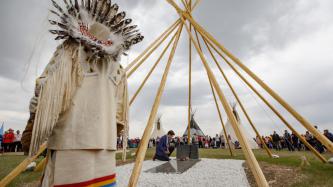
On a windswept hill in Saskatchewan in May 2019, members of the Poundmaker Cree Nation gathered to witness history being corrected. Prime Minister Justin Trudeau stood at Cut Knife Hill – the very site where Cree warriors had clashed with Canadian troops 134 years earlier – and formally exonerated Chief Poundmaker of the treason conviction that had tarnished his name. It was a moment of catharsis and vindication. Poundmaker, known in Cree as Pîhtokahanapiwiyin, had long been revered by his people as a wise leader and peacemaker. Now, at last, Canada’s government acknowledged what the Cree had always known: that Chief Poundmaker was not a criminal rebel, but a defender of his people who “worked tirelessly to ensure the survival of his people, and [to] hold the Crown accountable to its obligations as laid out in Treaty 6”. This ceremonial exoneration, more than a century after Poundmaker’s death, is emblematic of a broader journey of reconciliation – a journey that winds through the fraught history of colonial treaty-making, resistance to injustice, and the ongoing effort to right historical wrongs.
Chief Poundmaker was born around 1842 in the prairies near present-day Battleford, Saskatchewan. His Cree name, Pîhtokahanapiwiyin, is often translated as “Poundmaker,” a reference to his skill in constructing buffalo pounds – corrals used to trap bison for communal hunting. He was the son of an Assiniboine (Nakoda) medicine man named Sikakwayan and a Cree mother who was the sister of Chief Mistawasis. Orphaned at a young age, Poundmaker was raised among his mother’s Cree relatives, developing a deep understanding of Cree traditions and the healing arts. Like his father, he became known as a gifted herbalist and healer. This early grounding in Indigenous knowledge and the experience of straddling multiple cultures would shape him into a thoughtful leader.
As a young man, Poundmaker also forged an unusual familial bond that would later bolster his influence. In 1873, the renowned Blackfoot Chief Crowfoot adopted Poundmaker as his son. This act was far more than symbolic – it created an alliance between two nations that had often been rivals. The adoption helped “cement ties between the Blackfoot and the Cree, successfully stopping the struggling over the now very scarce buffalo” on the plains. By formally becoming Crowfoot’s son, Poundmaker not only gained a powerful protector and advocate, but also became a living bridge between peoples. The peace forged through this kinship was vital at a time when the great buffalo herds – the lifeblood of the Plains Nations – were rapidly vanishing due to overhunting and environmental change.
Poundmaker’s rise as a leader coincided with an era of profound upheaval on the prairies. Small in stature but commanding in presence, he earned respect as an orator known for clear vision and compassion. After years of intertribal warfare and increasing contact with European newcomers, the Plains Cree and other Indigenous nations faced a pivotal crossroads in the 1870s. The newly-formed Canadian government was pushing westward, eager to secure the land for settlement and the construction of a transcontinental railway. Amid this pressure, a series of negotiations known as the Numbered Treaties began, aiming to strike agreements between the Crown and First Nations. Poundmaker emerged as a prominent voice for his people during this critical period.
In August 1876, at Fort Carlton, representatives of the Plains Cree met with Crown officials to negotiate Treaty 6 – an agreement that would fundamentally shape the future of the region. Poundmaker, then in his mid-30s, attended the talks as a headman and influential advisor within the Cree delegation. From the outset, he proved himself a principled negotiator. With bison numbers dwindling and new diseases and settlers encroaching, Poundmaker pressed the government’s negotiator, Lieutenant-Governor Alexander Morris, for firm guarantees to protect the Cree’s future. He “argued that the Government of Canada had to provide the appropriate assistance to the Cree as life in the Prairies was changing,” and insisted that the treaty’s benefits must extend to future generations of his people. In essence, Poundmaker and other Cree leaders wanted the treaty to serve as a bridge to a sustainable future, not a one-time transaction of land for trinkets.
One crucial promise Poundmaker advocated was the inclusion of what became known as the “medicine chest” clause in Treaty 6. This provision committed the government to provide medicine and healthcare in times of need – a forward-looking demand that reflected Poundmaker’s concern for the well-being of his people beyond the immediate moment. He also pushed for famine relief assurances. Oral histories recall him calling for help “in times of famine” and other hardships, keenly aware that the transition away from a buffalo-hunting economy would be perilous. Indeed, Treaty 6 ultimately included a promise that the Crown would aid the Cree in the event of pestilence or famine, as well as the famous medicine chest clause providing for medical assistance on reserves. These were hard-won concessions, born of leaders like Poundmaker persisting in negotiation until their concerns were heard. As one historian notes, “Poundmaker was not against the concept of the treaties, but he wanted a treaty that would make sense to his people,” one that showed genuine respect and provided practical provisions for their survival.
Treaty 6 was signed in 1876, but the ink on the parchment did not end the struggle for Poundmaker and his band. Shortly after the treaty, Poundmaker parted ways with some of the older chiefs and in 1879-80 formed his own band of followers who looked to him as their chief. By 1881, he led over 180 Cree, who settled on a reserve about forty miles west of Fort Battleford (an area that today bears his name, the Poundmaker Cree Nation). From this new position of leadership, Chief Poundmaker quickly gained a reputation as an outspoken advocate for the rights promised under Treaty 6. He would travel to meet government officials and use his considerable oratorical skills to remind them of the Crown’s obligations. “He wanted respect shown to his people, and provisions that they would need in times of famine,” as one account describes. However, the years following the treaty brought little of the promised support. Instead, they brought frustration.
The Canadian government’s implementation of Treaty 6 was lethally slow and often willfully negligent. Critical treaty promises – such as adequate rations, farming equipment, and relief during disasters – went unfulfilled or were delivered sparingly. By the early 1880s, the Plains Cree were grappling with starvation as the buffalo herds had all but disappeared. Government agents, under directives from Ottawa, strictly controlled food distribution and sometimes used it as a tool to enforce compliance. Poundmaker and other leaders like Big Bear (Mistahimaskwa) repeatedly petitioned officials to live up to what had been agreed: food for the hungry, aid for the sick, seed and tools for farming. These requests were often met with indifference or disdain. With each winter that passed, more Cree families went hungry on reserves that were remote and lacking game. The treaty rights Poundmaker championed – the very rights meant to ease the transition to agriculture and ensure survival – were being ignored.
By 1884, tensions on the plains were at a breaking point. Chief Poundmaker had become a vocal critic of Indian Affairs officials, openly denouncing their failures to uphold Treaty 6. The young Cree chief, once noted for his calm reasoning, now warned that if the government would not listen to peaceful appeals, desperation might lead to violence – not as a threat, but as a fearful prediction. At the same time, in 1884, he hosted a large intertribal gathering on his reserve where Cree, Saulteaux, and Assiniboine leaders discussed their grievances. Witnesses recalled that Poundmaker still counselled patience and peace, but he also stood firm that the Cree would not be “sitting by the trail” while their people starved. This was the context in which the Northwest Resistance – sometimes called the Riel Rebellion – ignited in 1885. It was less a sudden insurrection than a breaking point after years of broken promises.
In the spring of 1885, as Métis leader Louis Riel and his followers took up arms in Saskatchewan, Poundmaker’s band did not initially intend to join any armed rebellion. They were, however, resisting in their own way – resisting hunger, poverty, and the betrayal of treaty commitments. Poundmaker’s priority was to keep his people alive. With government rations cut and the bison gone, the Cree at Poundmaker Reserve faced famine that winter. In late March 1885, Poundmaker and a group of his band, along with allied Stoney Nakoda and Cree from nearby reserves, traveled to the town of Battleford to seek provisions. By then, paranoia had gripped settler communities due to news of Riel’s uprising. When Poundmaker’s party arrived near Battleford on March 30, 1885, they found the town eerily deserted. The terrified townspeople had abandoned their homes and barricaded themselves inside the North-West Mounted Police fort, convinced that the Cree’s approach meant an attack. In reality, Poundmaker had come to request food and to reassure the local Indian Agent of his peaceful intentions after a recent unrelated violent incident in the area. But fear and misunderstanding prevailed.
For two days, Poundmaker’s camp waited outside Fort Battleford while the Indian Agent, Rae, refused to emerge from the stockade. Hunger drove some members of the Cree party to scavenge for supplies in the abandoned town. Exactly what happened next has been debated and colored by prejudice. Looting did occur in Battleford, but even the settlers could not agree on who was responsible – some later admitted that “most of the looting had already been done by whites” before any Cree entered the town. Others blamed Poundmaker’s followers, while Cree oral tradition holds that it was a band of Nakoda (Stoney) allies who took advantage of the empty houses, despite Poundmaker’s efforts to stop them. Regardless, the incident was seized upon by Canadian authorities as evidence of an “Indian uprising.” In reality, as Floyd Favel of Poundmaker Cree Nation later observed, “We weren’t resisting anything. We were asking for the promises due” – in other words, they were driven by desperation and the justice owed to them under Treaty 6. But to settlers and officials primed to see treachery, the Cree’s actions in Battleford were cast as rebellion.
After the standoff at Battleford, Poundmaker withdrew his band and the other families back to the safety of their camp at Cut Knife Hill, a wooded high ground on the reserve about 40 km away. There, in early May 1885, the Plains Cree would face the full force of a colonial military response. On May 2, 1885, Lieutenant-Colonel William Dillon Otter led an armed column of over 300 Canadian militia and NWMP troopers in a dawn assault on Poundmaker’s camp. The attack, meant to punish the Cree for the alleged “looting” and to subdue any rebellion, ignited what is known as the Battle of Cut Knife. War cries rang out through the cool spring air as Cree warriors and a small number of allied Métis fighters hurried to defend the camp. For seven intense hours, fighting raged around Cut Knife Creek. Despite being outgunned and surprised, the Cree defenders outmaneuvered Otter’s troops, who found themselves in a desperate situation. Cree marksmen picked off soldiers who ventured too far forward, and Cree women and children took shelter in the coulees. By afternoon, Colonel Otter realized his force was near defeat – a shocking turn, as the skirmish was the first time Canadian troops had been bested by Indigenous fighters in these resistance conflicts.
As Otter ordered a retreat, enraged Cree warriors prepared to pursue and potentially annihilate the fleeing soldiers. It was then that Chief Poundmaker stepped forward to prevent further bloodshed. Notably, Poundmaker had not personally fired a shot during the battle; some accounts say he stayed in the background, acting as a leader and spiritual supporter rather than a combatant. As his warriors gained the upper hand, Poundmaker intervened at a critical moment. He carried a ceremonial pipe belonging to a wounded war chief onto the battlefield and used his authority to coax his fighters into holding back. “At a critical time, he… used his considerable authority to stop the counterattack on Colonel Otter’s retreating troops, thereby avoiding more bloodshed,” recalls the official record. Poundmaker’s choice almost certainly saved lives on both sides; had the Cree pursued, the retreating soldiers might have suffered heavy casualties, and the Canadian forces in turn would likely have returned with greater vengeance. This mercy in victory further cemented Poundmaker’s reputation among his people as a peacemaker at heart, even amid conflict. But in the eyes of Canadian officials, the very fact that he had successfully resisted their troops – however defensively – marked him as a dangerous rebel.
In the weeks after Cut Knife, the broader Northwest Resistance collapsed. Métis fighters were defeated at the decisive Battle of Batoche in mid-May 1885, and Louis Riel surrendered. Poundmaker and his band, though hungry and exhausted, had yet to be broken militarily – but Chief Poundmaker was unwilling to see his people suffer further or be labeled traitors. Ever the diplomat, he sought out Major-General Frederick Middleton, commander of the Canadian forces, to negotiate peace. Poundmaker even voluntarily disarmed his followers as a sign of good faith. Finally, on May 26, 1885, Chief Poundmaker formally surrendered at Battleford, accompanied by a small group of his Crees. According to accounts, he told the Canadian officers, “You did not catch me. I gave myself up. I wanted peace.” There would be no violent last stand. Poundmaker believed he could explain his position and seek justice through dialogue. Unfortunately, the Canadian authorities were not interested in nuance or context – they needed scapegoats to blame for the Northwest Resistance and examples to discourage future defiance.
Chief Poundmaker’s surrender was swiftly followed by his arrest and a journey in chains to a jail cell in Regina. Although he had been instrumental in preventing a larger massacre, the government chose to make an example of him. In August 1885, Poundmaker was put on trial in Regina for the charge of “treason-felony,” accused of rebelling against the Crown. The proceedings were a spectacle of prejudice and predetermined judgment. Poundmaker stood before an all-white jury and judge, unable to properly explain his actions or motives in a language and legal system stacked against him. The evidence of his so-called treason rested largely on the events at Battleford (the looting of which he denied involvement) and a letter written by Louis Riel that had mentioned Poundmaker’s name in passing. It did not seem to matter that Poundmaker had consistently advocated for peace or that he had surrendered voluntarily.
During his trial, Chief Poundmaker spoke with dignified resolve, rejecting the false image of him as a rebel leader. In a statement remembered for its poignancy, he addressed the courtroom: “Everything that is bad has been laid against me this summer, there is nothing of it true… Had I wanted war, I would not be here now. I should be on the prairie. You did not catch me. I gave myself up. You have got me because I wanted justice.” These words – “I gave myself up… I wanted justice” – encapsulate the tragedy of Poundmaker’s situation. He sought justice from the very system that was bent on punishing him to justify its own harsh policies. The court was unmoved. Poundmaker was found guilty of treason-felony in that August 1885 trial. Before sentencing, he expressed again that his conscience was clear, knowing he had tried to “stop bloodshed” rather than incite it. Nevertheless, he received a three-year sentence to Stony Mountain Penitentiary in Manitoba.
Poundmaker’s imprisonment was a devastating blow not only to him personally but to his entire community. The Canadian authorities, eager to suppress any lingering spirit of resistance, portrayed him as a dangerous traitor. The Poundmaker Cree Nation – his band – was harshly punished in the aftermath. Branded a “rebellion band” by the government, they were subjected to collective penalties. The band members were forced to surrender their weapons, leaving them unable to hunt or adequately protect themselves on the harsh plains. Worse, the government refused to recognize any new chief for the band for over 30 years. For more than three decades, the people of Poundmaker’s reserve had no official chief, effectively crippling their self-governance. This was an deliberate strategy under the oppressive Indian Act system to break the spirit of any community that had been associated with the 1885 resistance.
Other facets of the Indian Act regime tightened like a noose around the Cree in this period. In 1885, officials implemented the notorious pass system, initially targeting so-called “rebel Indians” but soon extending to all First Nations on the Prairies. Under this unofficial yet enforced policy, Indigenous people could not leave their reserves without a written pass signed by an Indian Agent, specifying their destination and return date. It was essentially a regime of internal passports designed to confine First Nations to their allotted lands. Alongside this came the permit system, requiring Indigenous farmers to obtain permission to sell their produce or purchase goods. These measures, never sanctioned by any treaty, were imposed in the wake of 1885 as tools of control and assimilation. The government’s goal, as stated plainly by officials like Hayter Reed and Prime Minister John A. Macdonald, was to “break up the tribal system” and enforce a peasant-like farming model on the Plains Cree. The authorities viewed the proud, independent leadership of men like Poundmaker as an obstacle to their colonial project. Now, with him behind bars, they moved swiftly to dismantle the last vestiges of autonomy and mobility for his people. In the span of a year, the Cree had gone from negotiating treaty terms as equals to living under near-apartheid conditions – confined, disarmed, and supervised at every turn.
Poundmaker’s personal fate was as cruel as the injustice done to his name. The once-robust leader fell gravely ill in prison, suffering from lung problems likely exacerbated by the damp and poor conditions of his cell. Perhaps ironically, it was Chief Crowfoot’s influence – the same adoptive father who had given Poundmaker a ceremonial place of honor years before – that spared him the worst treatment behind bars. Officials, wary of offending the powerful Blackfoot chief, ensured that Poundmaker’s hair was not shorn in prison (cutting an Indigenous man’s hair was a typical indignity inflicted on prisoners) and they quietly arranged for his early release. After serving just seven months of his three-year sentence, Poundmaker was freed in March 1886, his health irreparably damaged. He journeyed to Blackfoot Crossing in present-day Alberta to visit Crowfoot, seeking rest and refuge among the family that had adopted him. But only four months after he left Stony Mountain Penitentiary, on July 4, 1886, Chief Poundmaker died. At the age of 44, he succumbed to a pulmonary hemorrhage (a bleeding lung), likely a result of tuberculosis or the lingering toll of imprisonment. According to reports, his final days were spent in sorrow over the plight of his people. He was buried at Blackfoot Crossing, far from the home he had fought to protect. Not until 1967 would his remains be exhumed and reinterred on his own reserve at Cut Knife Hill, in a symbolic homecoming for the great leader.
For the Cree and many other Indigenous people of the prairies, Chief Poundmaker’s legacy was never truly defined by the Canadian court that branded him a felon. In Cree oral history, he is remembered as a wise chief and a peacemaker who stood up to injustice yet sought to minimize violence. Elders passed down stories of Poundmaker’s eloquence during the Treaty 6 talks, his compassion in feeding orphans, and his bravery in 1885 tempered by mercy. His famous restraint at Cut Knife Hill, preventing his warriors from pursuing a defeated enemy, became a proud tale – evidence that the Cree, even in victory, held to their values of honour and humanity. Likewise, Poundmaker’s warnings about the “trail” – his metaphor for the path forward – resonated through generations. “We can never forget what has happened, but we cannot go back. Nor can we just sit beside the trail,” he had said, urging his people to keep moving forward despite hardship. Those words would later be cited as a guiding philosophy: a call to remember the past but not be paralyzed by it.
Yet for much of Canadian history, the mainstream narrative cast Poundmaker and others like him in a far less favorable light. In school textbooks and official histories of the 20th century, Poundmaker was often depicted as a leader of an “Indian rebellion,” a troublemaker who got his just deserts. Only slowly did that perception begin to shift, thanks in large part to Indigenous voices who insisted on telling their side of the story. The Poundmaker Cree Nation itself kept the memory of their namesake hero alive, even when Ottawa refused to acknowledge a chief. In 1972, nearly a hundred years after the treaty and almost 90 years after Cut Knife, Poundmaker’s grandson Jimmy Poundmaker unveiled a plaque at the battle site honoring the Chief’s role and reputation. The community also fought to preserve Poundmaker’s possessions and history. A museum was established on the Poundmaker reserve in the 1990s, which after some hardship was revived and expanded in recent years. That museum, as curator Floyd Favel notes, became “the heart of the community,” a place where elders’ oral histories and youth education converged to celebrate Chief Poundmaker’s life. Through powwows, storytelling events, and exhibits – such as the display of Poundmaker’s rifle and ceremonial staff, repatriated on loan from a national museum – the Cree community asserted pride in their revered leader. They never forgot that Poundmaker was “widely known as a peacemaker,” whatever colonial records said.
A historical photograph of Chief Poundmaker (seated, left) with one of his wives, taken circa 1884. Poundmaker was widely respected among the Cree as a leader who combined strength with compassion. His calm dignity is evident in this portrait, made not long before the events of 1885 that would see him unjustly imprisoned.
As the Indigenous rights movement grew in the late 20th and early 21st centuries, there was increasing pressure on the Canadian government to revisit historical injustices. The Truth and Reconciliation Commission (2008–2015) and its Calls to Action urged Canadians to learn the real history of figures like Poundmaker and to address the lingering trauma of colonization. In this spirit, leaders of the Poundmaker Cree Nation began actively campaigning for the exoneration of Chief Poundmaker. They argued that clearing his name was not only a matter of justice for one man, but a powerful symbol of reconciliation for the country. “Exonerating Poundmaker would be a simple act of justice and reconciliation,” explained band councillor Milton Tootoosis in 2017, as he and others lobbied federal officials to posthumously exonerate the chief. The Federation of Sovereign Indigenous Nations and the Assembly of First Nations both passed resolutions supporting this effort. For the Poundmaker Cree, who had endured the stigma of the “rebel band” label for generations, an exoneration would officially acknowledge that their Old Chief had been wronged by the Crown – and by extension, that the Cree’s resistance in 1885 was born from valid grievances, not treachery.
After years of advocacy, that moment of acknowledgement finally arrived. On May 23, 2019, Prime Minister Trudeau visited the Poundmaker reserve, stood at the very battlefield where the Chief had once stood, and delivered an emotional Statement of Exoneration. In it, the Government of Canada fully absolved Chief Poundmaker of any wrongdoing and apologized “on behalf of all Canadians” for the injustices he and his Nation suffered. Trudeau recognized Poundmaker as “an important leader who never stopped fighting for peace” and affirmed that “Chief Poundmaker was not a criminal”. Members of the Cree Nation present at the ceremony described a sense of ancestors in attendance – a spiritual weight lifting after 134 years. The Prime Minister quoted Poundmaker’s own words about not sitting beside the trail too long, conceding that Canada had itself “been sitting beside the trail for far too long” in denying the truth. In that moment, the historical record and Indigenous oral history finally converged in agreement.
The exoneration of Chief Poundmaker, though largely symbolic, carries profound meaning. It serves as a public correction of the record – an official admission that the label of “traitor” was wrongly applied to a man who sought to uphold the very treaties that Canada had broken. It invites Canadians to reconsider the narrative of the 1885 Resistance: not as a simple rebellion quashed by brave Mounties, but as a more complex story of a people pushed to the brink by starvation and injustice. In a broader sense, Poundmaker’s story illuminates themes that still resonate today: the quest for Indigenous treaty rights, the painful history of dispossession and the Indian Act’s repressive legacy, and the ongoing journey toward reconciliation between First Nations and the Canadian state. As Chief Poundmaker’s descendant Celeste Tootoosis said, the act of remembering and honoring ancestors like Poundmaker is not about dwelling in victimhood; it is about sharing culture, learning from the past, and building a better future. “The past can easily be forgotten,” she noted, “but in our culture, we don’t forget… when we celebrate, we eat with our ancestors”. By clearing Poundmaker’s name, Canada has made a step – one of many needed – toward “eating with” and acknowledging those ancestors, rather than erasing them.
In the twilight of his life, a sick and weary Poundmaker reportedly told his friend and mentor Crowfoot, “We all know the story about the man who sat by the trail too long, and then it grew over, and he could never find his way again”. He urged that one cannot simply sit and lament the past; one must move forward. Today, Chief Poundmaker’s life story is widely taught as that of a hero who tried to walk a path of peace, even as he resisted oppression. His journey from respected negotiator to wrongfully convicted prisoner, and finally to exonerated historical icon, mirrors the journey of Indigenous peoples in Canada – from sovereign nations to subjugation and now toward self-determination and healing. The man who once fought only for “the promises due” to his people is now recognized for the visionary leader he was. As Canada continues down the road of reconciliation, the spirit of Chief Poundmaker – Pîhtokahanapiwiyin – stands as a guidepost on that trail, reminding all of the power of truth and the importance of never giving up the fight for justice and mutual respect.